
 E-Paper



Supertech twin-tower case: Supreme Court's orders on demolitions underline rule of law, public safety
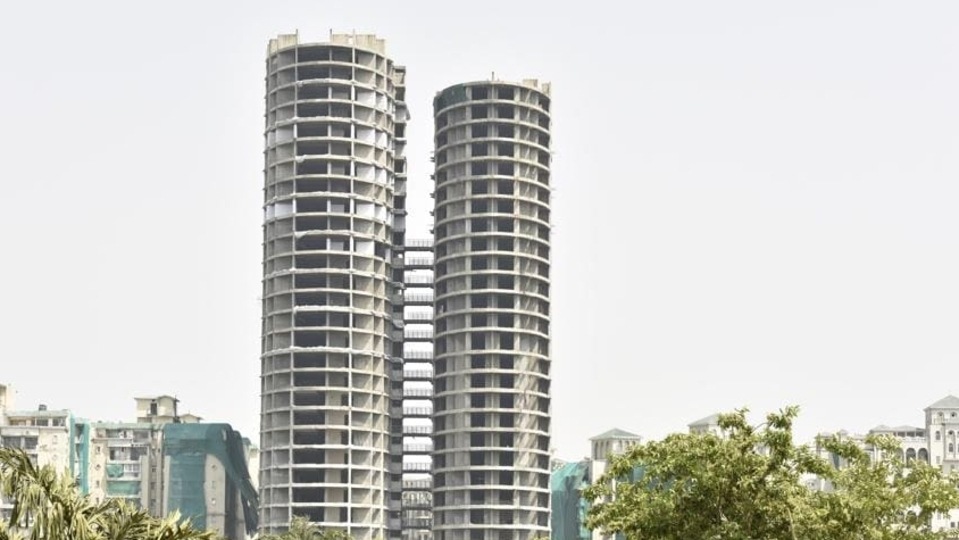
Two high-rise residential towers of Emerald Court housing society in Noida built by realty firm Supertech are to be demolished by August 28 after the Supreme Court on August 31 last year found them to be illegally constructed.


Work is underway to demolish two high-rise residential towers of Emerald Court housing society in Noida built by realty firm Supertech by August 28 after the Supreme Court on August 31 last year found them to be illegally constructed, agreeing with the earlier directions of the Allahabad high court.
This is not the first time that judicial action will cause such huge structures to be razed despite the huge investments made to build them. The apex court has in the recent past pronounced stern judgements to arrest the scourge of corruption and collusion by builders and concerned authorities that threaten not just public safety but also the rule of law.
It took years for Supertech to build the two towers that will now be brought down in a matter of seconds. What went wrong that two courts — the Allahabad high court in April 2014 followed by the Supreme Court in August last year — gave concurrent directions to demolish the towers?
These towers stood as a blatant example of corruption, collusion by the builder and landowning authorities, which was exposed before the two courts by the residents of Emerald Court. In their petition before the high court, they provided proof of how the two towers of 40 stories was built on a space earmarked as an open, green area.
The new construction also breached the minimum distance between two towers fixed under the National Building Code of 2005. The narrow passage between the two towers prevented access to fire engines and blocked air, light to residents of other towers, besides squeezing parking areas.
The top court pulled up the authorities for their brazen disregard to law in permitting such construction. There is also an investigation underway to uncover the nexus between the builder and Noida officials, who hatched the conspiracy to cheat the law.
The order by the court brought back memories of a similar exercise carried out by the Supreme Court to raze four apartment complexes in Kerala’s Ernakulam district. By a common order of May 8, 2019, the top court directed demolition of Golden Kayaloram, Holy Faith H2O, Alfa Serene and Jains Coral Cove, housing over 1,000 residents in close to 330 flats. Situated close to the Vembanad Lake in Ernakulam, the buildings did not have the permission from the Kerala Coastal Zone Management Authority (KCZMA).
The KCZMA faulted these constructions for being in critically vulnerable coastal areas. The building permissions were issued by local panchayats without consulting the state’s coastal zone authority and this proved to be the clincher for judicial action.
“The construction activities of the respondent builders are on the shores of the backwaters in Ernakulam in the state of Kerala which supports exceptionally large biological diversity and constitutes one of the largest wetlands in India,” top court said in its May 2019 order.
Protecting the environment
In taking a hard stance in favour of environment, it sounded caution for the future. “Uncontrolled construction activities in these areas would have devastating effects on the natural water flow that may ultimately result in severe natural calamities,” the court noted.
Such scrupulous adherence to law is not new to courts. Faced with the call of duty, and not just houses, the Supreme Court has not shied from wiping out an entire colony. This happened in September 2018, when Kant Enclave, a township situated in Haryana’s Faridabad district bordering Delhi, was ordered to be razed because it was illegally built on forest land in the Aravali hills.
The colony, spread over almost 400 acres, was conceived by R Kant & Co after the company got exemption from the state government in 1984 to set up a film studio and associated facilities. In August 1992, the state government brought the land in question under the Punjab Land Preservation Act, 1900, by which all construction activity was halted. However, the company delineated 1,600 plots and executed conveyance deeds in favour of 284 persons. Most construction took place after the date of notification.
This caught the attention of the top court when it was considering the protection of Aravali forest land. By an order of September 11, 2018, it declared the entire colony illegal and ordered its demolition within three months. At the time of passing the order, there were persons staying in 33 plots, who were asked to vacate.
It was another bold instance when the court refused to shirk from its responsibility of being the protector of country’s natural wealth. Looking at the scale of exploitation and encroachment of Aravali forests, the judges had exclaimed, “It is painful to see such a mockery of the law and total lack of concern for the environment and ecology of the Aravalli hills….There is no doubt that irreversible damage has been caused to the environment and ecology of the Aravalli hills.”
Holding the state government equally to be at fault, the bench in its judgment had observed: “The extent of violation of the August 18, 1992 notification is quite frightening and one can only imagine the phenomenal environmental and ecological damage caused to the area by the applicants. This could not have happened without the knowledge of the State of Haryana and its officers who permitted blatant disregard of the rule of law.”
Homebuyers take the hit
Every demolition has a story behind it, but nothing is as stark as the hardship residents in these buildings have to face with their houses are reduced to rubble and compensation that is paid is too little, too late.
Take for example the Supertech case. Even after the Supreme Court’s ruling, the compensation proceedings are pending before the top court as residents wait for refund of their investments. The judgment of the court noted that 252 out of the 633 flat buyers in the two towers were eligible for refund, along with 12% interest.
The court appointed advocate Gaurav Agrawal as amicus curiae (friend of court) to calculate the sum payable to homebuyers as Supertech disputed their claims. Some buyers filed contempt petitions against the real estate firm. After the amounts were determined by Agrawal that were agreeable to both sides, many received the amounts. For those who remained, the court directed Supertech to complete all pending payments by March 31.
With just days remaining for this deadline to expire, the National Company Law Tribunal (NCLT) declared Supertech insolvent on a plea by the Union Bank of India over unpaid dues. An interim resolution professional has since taken over the management of the company and the court is making efforts to secure the amounts due to homebuyers. The matter is pending.
This is not the lone case related to compensation that is stuck in the top court. Following the demolition ordered of the Kerala apartments, the refund issue remains unresolved. After the buildings were brought down in October 2019, many residents are yet to receive the full amount of what they paid at the time of purchase. Under the top court’s monitoring, a committee headed by a retired Kerala high court judge was formed to ascertain the amounts payable and the committee is still executing payments.
Realizing the plight faced by residents who had documented records showing right over the property and yet were being rendered homeless, the court on September 27, 2019, directed the Kerala government to pay an interim amount of ₹25 lakh to each of the evicted flat owners. This amount was to be recovered from the builder or erring officials responsible for raising the construction.
The proceedings in this regard are ongoing. In April this year, when the matter was last heard, advocate Agarwal, who is assisting as amicus curiae in this matter as well, informed the court that out of the four building complexes, refunds were complete for three, with Holy Faith builders being the lone defaulters.
The Court was informed that apart from the ₹25 lakh received from the state government as interim compensation, the residents of Holy Faith H2O had not received a penny from the builder. Efforts by the committee constituted by the court to extract the amount did not yield results as the existing properties of the builder were insufficient to meet the liability of over ₹22 crore payable to affected homebuyers.
The issue may only get prolonged as the top court is now faced with requests from homebuyers claiming interest on the principal amount refunded back to them. As an alternative, they have even prayed to the top court to pay them the market rate for their flats as existing on the date of demolition. These applications are yet to be decided by the top court. In addition, the Kerala government which incurred a liability of ₹62.75 crore for paying the interim compensation to homebuyers is at odds with the builders to recover its amount.
As regards the demolition of Kant Enclave, the mater has not come back to court over refund woes faced by residents. The court ordered a compensation of ₹50 lakh to be awarded for the 33 Kant Enclave residents whose houses were demolished. This amount was to be shared equally by the company, R Kant & Co, and the state government’s town and country planning department.
The court further directed the company to refund the amount collected from all 284 plot purchasers, along with 18% interest. Realizing the damage caused by the township to the environment, the court asked the company to set apart a sum of ₹5 crore with the Aravali Rehabilitation Fund to restore damaged forest areas.
The judgment mentioned any aggrieved person seeking to challenge the compensation amount would do so by filing a suit in a civil court against the developer. This being a tedious and long-drawn process, little is known of the fate of any such litigation.
Public safety concerns
In the above instances, one could see the court’s stern face against violators of law and an equally a humane face towards innocent citizens requiring just compensation. But there have also been orders on demolition by the top court where competing interests have not essentially been protecting nature vis-à-vis non-adherence to rule of law by the state or individuals.
This was seen in a recent verdict where the court ordered a vestigial property in Bihar to give way on grounds of public safety. The order passed on May 13 paved the way for the demolition of an 18th century structure in Bihar’s capital city, which served as the state collectorate building, housing several government offices.
As the building was in a dilapidated state, the state government decided in July 2019 to raze the structure that was built by the British to serve as a godown to store opium and saltpetre.
This decision was opposed by the Indian National Trust for Art and Cultural Heritage (INTACH), Patna Chapter, which sought preservation of the building, claiming it to be an integral link to the city’s culture and heritage. The state government, on the other hand, saw the building posing a serious threat to public safety that required immediate demolition.
Weighing the two arguments, the bench ruled in favour of the state. “This building endangers safety of innocent citizens,” it said. Human lives cannot be endangered by keeping the structure standing, the court said. At the same time, the bench ruled that not all buildings of colonial era can be said to have historical value, requiring them to be preserved.
Public safety was again the guiding principle in May 2016, when the top court ordered an under-construction 11-storey structure in Chennai to be razed. This structure was part of a twin-tower project developed as a residential project by Prime Sristi Housing. The top court’s order followed a major tragedy that occurred on June 28, 2014, on the project site when one of the towers collapsed, killing 61 persons, mainly construction labour.
The court constituted an expert team to examine the lone standing structure and found it to be unsafe. The structure was brought down in November 2016 using explosives. A similar exercise awaits to be carried out at Noida, when the two Supertech towers will fall.
A guide for future
Nothing is mighty to stand before the Supreme Court’s tall order. A demolition once pronounced must take place. The court has even set timelines for carrying out the demolitions. But sadly, the timeline for refund is hardly in place.
As a result, while the dust has settled on the constructions deemed illegal by the courts, the residents are still awaiting refund. It’s a long wait and often prolongs the misery faced by residents as after the action of demolition gets over, the matter is seldom heard by courts.
Edifice Engineering, the firm engaged by Supertech as the demolition agency, has told the Supreme Court: “This is the demolition of the tallest structure in India till date” and is expected to take 8-9 seconds. One would hope that as an example to be set for future, homebuyers get to see the refund before they see the home of their dreams reduced to rubble.


